How Sevdara was born
The Notebook on the Kitchen Table
Jelena Stamenova
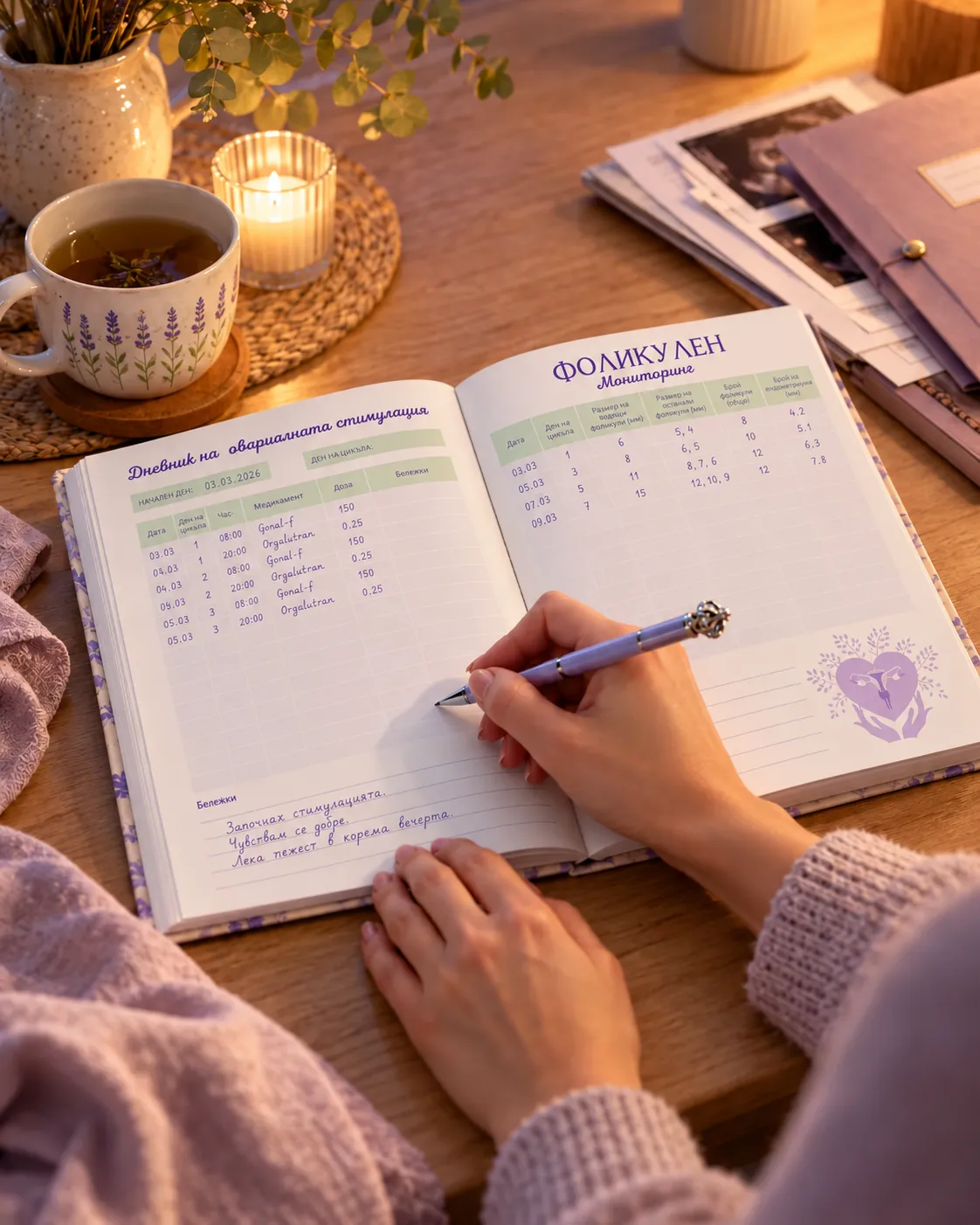
There is a particular silence in the waiting rooms of fertility clinics. I learned it first in Bulgaria, and later, in another language, in Turkey. It is the silence of women holding a folder on their knees and a hope they don't dare say out loud. They carry it carefully, the way you carry a glass filled to the brim.
When we began, I thought the hardest part would be the waiting. I was wrong. At first, the hardest part was the language. Nobody had told us that this road has a dictionary of its own. Stimulation protocol. Antagonist. Trigger. AMH, FSH, estradiol. Follicles counted and measured in millimetres. Blastocyst. Grades that looked like school marks — 4AA, 3BB — which we read again and again late at night, as if the letters could tell us who you would become.
Then came the paperwork. Referrals, consent forms, results, prescriptions — and a bag that grew heavier with every cycle. Results in Bulgarian, reports in Turkish, notes in English, and a phone full of photos of documents I could never find when the doctor asked for them. Alarms at 8:00 and at 20:00. Injections in the fridge, next to the butter. A calendar where every square meant something — and I was afraid of missing even one.
And beneath it all — the questions. Which vitamins, and how many? Coffee or no coffee? Should I move more, rest more, worry less? Everyone had advice. No one had a place where all of it could live together.
One evening, after a long day at the clinic, I sat down at the kitchen table and opened an ordinary notebook. I drew columns: date, medication, dose, time. On the next page — the results, and beside them, in small handwriting, what they meant, just as the doctor had explained it. On another — the follicles. Then the embryos, day after day. And on the last page, without planning to, I wrote down how I felt.
Something changed after that evening. At the next appointment I no longer rummaged through my bag. I opened the notebook to the right page, and the questions I had prepared the night before were waiting for me there. My husband could look and see where we were, what came next, what we were hoping for. The chaos had found its shape. And for the first time in a long while, I felt that I wasn't only walking this road — I was, a little, leading it too.
That notebook was crumpled, full of arrows and crossed-out lines, and endlessly precious. And the thought came quietly, the way important thoughts do: how many women are sitting at their own kitchen tables at this very moment, with the same folder and the same questions, feeling alone?
That is how Sevdara was born. The name comes from “sevda” — a word for a love so deep it aches, known in both Bulgarian and Turkish, the two languages in which our road was written. It is the journal I wish someone had handed me on the very first day: gentle, clear, with a place for every medication, every result, every tiny cell that dared to grow — and for everything the heart carries along the way.
Our road continues. We walk it hand in hand, with a hope we renew every morning. And every page of this journal holds a piece of that road — so that yours may be a little lighter, a little clearer, and never lonely.
— Jelena